

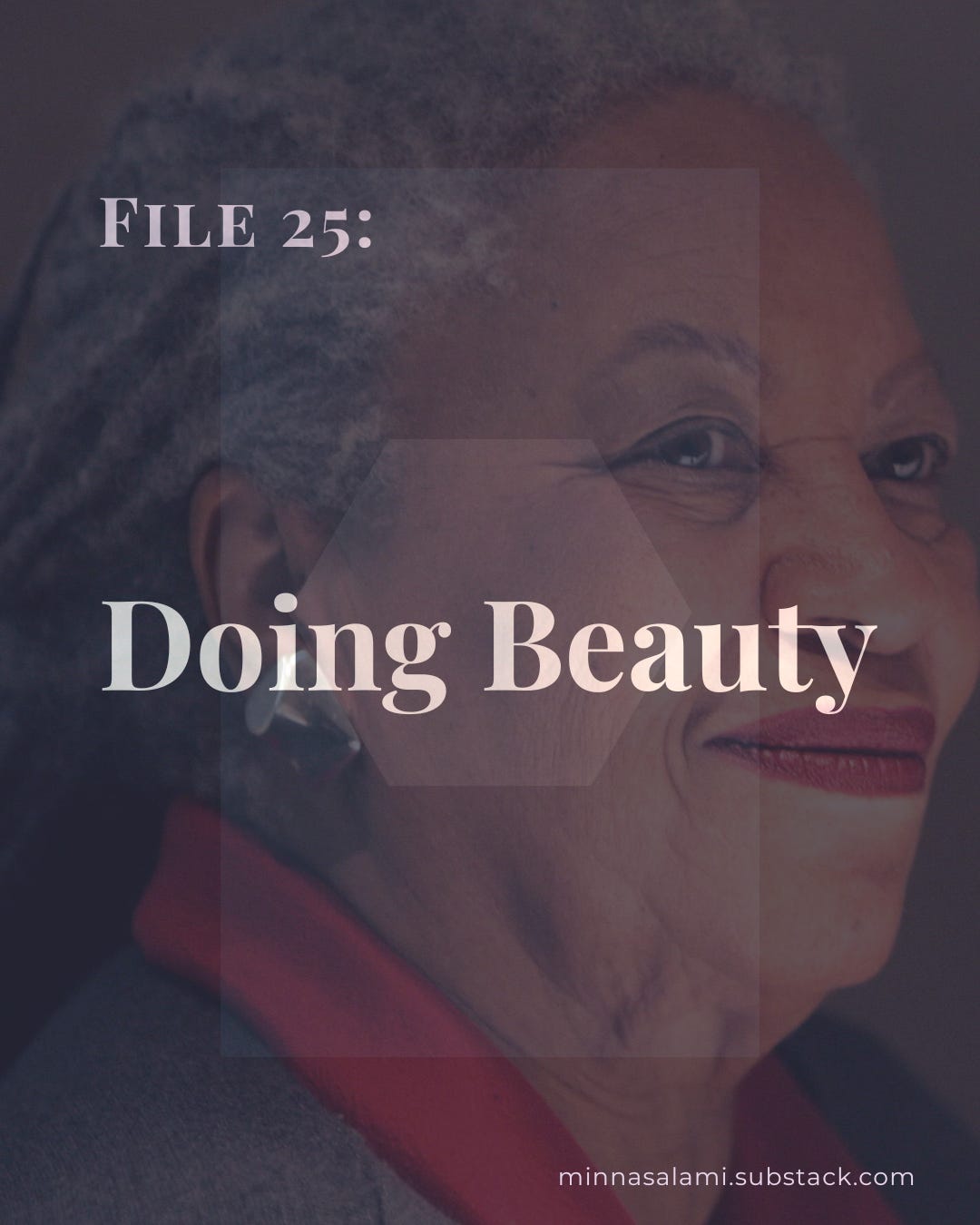
File 25: Doing Beauty
The legacy and power of Toni Morrison's body of work
Kaleido is a publication that names what others miss about our moment in history. If you find value from reading it, please consider supporting my work by subscribing, liking and sharing this essay, or buying me a coffee.
Today would have been Toni Morrison’s 95th birthday.
The occasion made me think about the passing of time, and the impact great literature can have on our lives. I was sixteen when I read my first Morrison novel, Sula. The novel catalysed a recognition that deep in my soul, I was a free spirit, even though my reality then was confined. I have Morrison to thank for that insight.
To thank, or to blame, depending on how you look at it. Reading the story about the bohemian, independent character Sula was like reading a diary, as though Sula’s memories were my own, despite the very different worlds we inhabited. Her bravura awakened in me a deep longing to defy the patriarchal order. But even at sixteen, I intuited that journey would be more challenging and lonely. Still, the glint of an authentic life that Sula embodied was motivation enough.
“When you gone get married? You need to have some babies. It’ll settle you.”
“I don’t want to make somebody else. I want to make myself.”
Morrison has since been a faraway mentor. She has inspired my writing and thinking, but it is the vision she bequeathed to history that I especially resonate with.
Any attempt to summarise Morrison’s vision is precisely that: an attempt. As is often the case with great thinkers, Morrison had many visions. Or perhaps it’s more accurate to say that her vision had many branches.
Yet, despite the multitude of forms her work takes, a singular thread runs through it. Many have sought to identify this thread, this vision. The scholar Andrea O’Reilly called it “a politics of the heart.” Patrick Bryce Bjork described it as “a search for self and place.” Valerie Smith captured it with the phrase “the writing of moral imagination.” Farah Jasmine Griffin speaks of a search for a “language for goodness.”
I call it doing beauty.
It’s a phrase I first wrote about in Sensuous Knowledge. It comes from Morrison’s first novel, The Bluest Eye, where her character Pecola—a Black girl who longs for the blue eyes that racist society has taught her represent beauty—eventually realises that “beauty is not simply something to behold; it is something one can do.”
In her novels, essays, and work as an editor, activist, mother, citizen, and what we know of her way of being, Morrison did exactly that. She turned the noun beauty into a verb. This is also how I think of sensuous knowledge, as a way of doing beauty that resists the enclosures of Europatriarchal Knowledge.
It wasn’t only Pecola, or for that matter Sula, but also Jadine, Sethe, Beloved, Milkman, Florens: characters who existed within the worst of what humanity has invented: slavery, rape, torture, dehumanisation. Yet in Morrison’s hands, their core preoccupations weren’t those horrors but rather the vicissitudes of love, community, betrayal, and desire. They lived under oppression, but they weren’t defined by it. There is a difference, and it has everything to do with beauty.
As Morrison once said:
“If I spend my life despising you because of your race, or class, or religion, I become your slave. If you spend yours hating me for similar reasons, it is because you are my slave. ...I will have shaped your life. That is the gift of your hatred; you are mine.”
Morrison endowed us with many gifts—but not that one. She didn’t offer her intellect to hatred or her creativity to whiteness. Even at the level of imagination, she refused domination.
Rather than fighting hatred, she asked: what do Black people mean to each other outside of the white gaze?
Her answer was beauty. We mean beauty. We represent beauty. She showed that doing beauty makes life a testament to freedom and meaning.
Beauty is, of course, a loaded word. It evokes pleasure, awe, wonder, and joy—but also manipulation, competition, and exclusion. Over centuries, it has been manufactured to mean something monolithic, marketable, and mass-produced.
It has been captured by mechanical and narrow understandings—attempts to categorise and domesticate beauty according to the reductive parameters of colonialism, patriarchy, apartheid, oligarchy, absolutism, white supremacy, technocracy, extractivism, nationalism, anthropocentrism, militarism, heteronormativity, and Eurocentrism.
None of these systems say anything about what beauty actually is. They speak volumes about ugliness. Oppression, hatred, and violence are ugly. American politics right now—which I’m sure has Morrison turning in her grave—is ugly.
Beauty, by contrast, has an ineffable quality. Despite the attempts of power, it cannot be empirically or temporally captured. It is ever-present and everlasting. It spans generations. It transcends space and time. It is a spirit that has surely been with us since the beginning.
Morrison once recalled the story of her house catching fire just after she had won the Nobel Prize in Literature. No one was hurt, but she lost manuscripts, photo albums, and belongings. Yet when asked what she was most upset about losing, she didn’t name a book, or a document, or a piece of furniture. It was the loss of her jade plant, which she had nurtured with quiet care over years.
I think of the jade plant as a symbol of her way with words. How she burned away everything inessential, everything ornamental. She let the fire take what needed to go, and kept the one living thing that mattered most. The nurturing of beauty.
And it seems to me that the message Morrison left us with is that simple: to do beauty, especially in the heat of the inferno.
Me too Minna, I read it in one sitting.
Thank you, it was really needed.
yes, yes, yes.